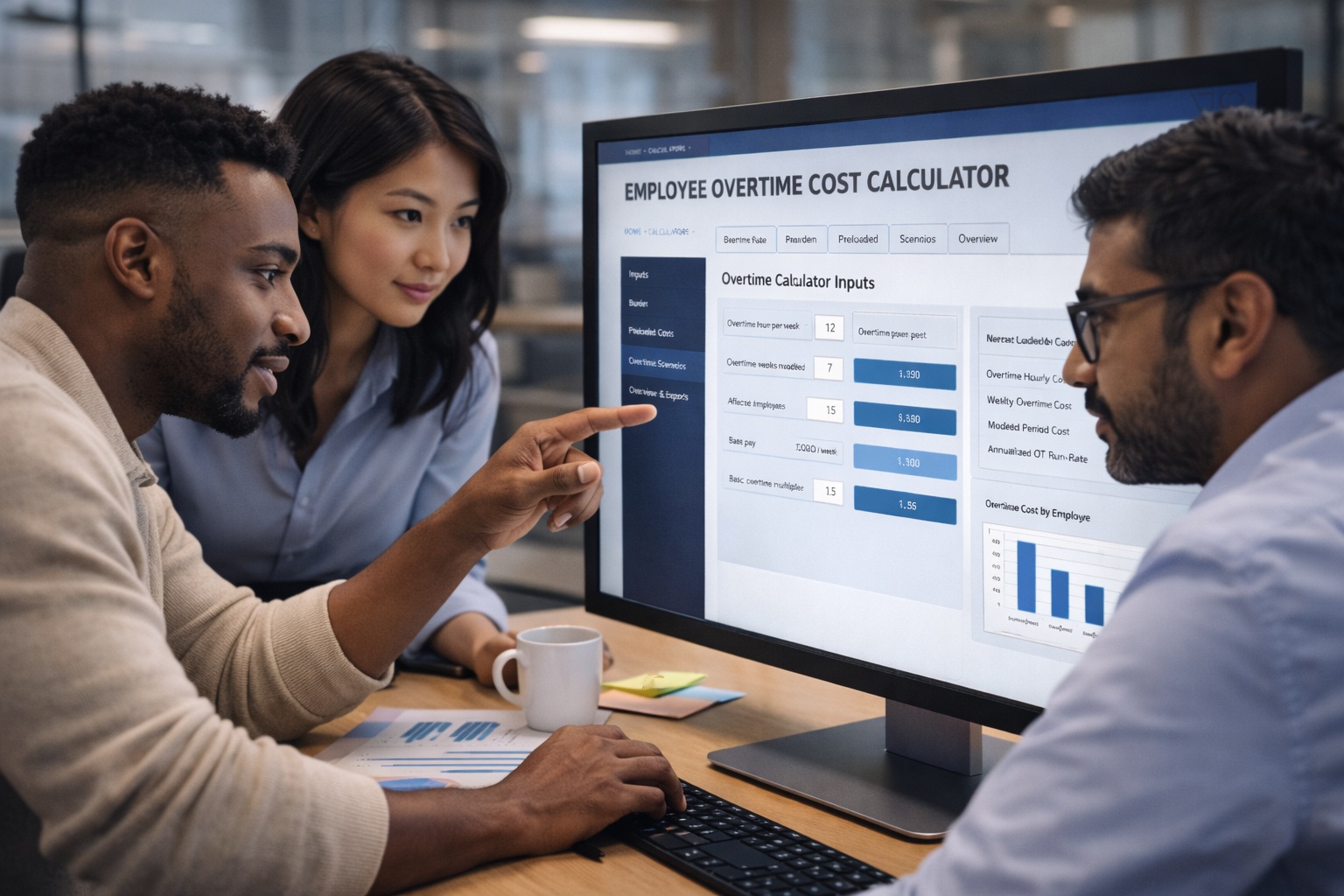
Executive summary: what leadership should see first
CFOs need to know whether overtime is a flexible short-term lever or an expensive substitute for unresolved capacity gaps. HR leaders need to know whether the same pattern is increasing fatigue, fairness complaints, turnover exposure, or schedule instability. The best overtime analysis answers both questions at the same time.
This is why the calculator should not be treated as a wage-only tool. Leadership needs a fully-loaded view that includes employer burden, shift premiums, policy effects, and the duration of the pattern. Once that view exists, the conversation shifts from “What did overtime cost?” to “Why are we buying coverage this way, and what is the better decision?”
Leadership takeaway: Overtime is useful when the demand spike is real and short. It becomes risky when the organization is repeatedly paying premium labor to cover a persistent operating gap.
Why overtime matters more than most teams realize
Many organizations rely on overtime because it feels immediate, flexible, and operationally simple. For a manager facing same-week demand, it can look like the least disruptive option. That convenience is real, but it also hides the fact that premium labor can accumulate quietly and distort both staffing economics and employee experience.
For finance, the risk is misclassification. A team may appear productive because output is being maintained, but margin can erode because the underlying labor model is becoming increasingly premium-heavy. For HR, the risk is normalization. Once after-hours work or extra shifts become routine, the organization may stop seeing a workforce stress pattern that would be obvious in a better dashboard.
That is why high-quality overtime reporting should combine cost accuracy with people context. CFOs need clean labor math. HR leaders need visibility into repeat exposure, hotspot teams, coverage fairness, and whether the same employees are carrying an unsustainable share of the load.
Use fully-loaded overtime math, not wage-only math
A wage-only calculation is easy to produce and easy to misinterpret. Enterprise decisions need a more complete model. Depending on your environment, that model can include employer payroll taxes, benefit burden, shift differentials, meal allowances, premium stacking, administrative overhead, and a scenario-based risk adjustment where chronic fatigue has financial consequences.
Not every organization should include every layer. Every organization should still decide which layers belong in the model instead of leaving them implicit. That decision alone improves trust because the assumptions can be reviewed openly by finance, payroll, HR, and operations.
Fully-loaded overtime cost
= overtime wages
+ employer burden
+ shift premiums / policy effects
+ meal or per-shift allowances
+ optional admin overhead
+ optional fatigue / risk premium

Period overtime cost
= fully-loaded overtime hourly rate
× overtime hours per week
× number of weeks
× affected employees
What CFOs should challenge
- Are we comparing premium labor against the right alternative, or against no alternative at all?
- Are benefits and employer burden included consistently across departments?
- Does the model distinguish one-time surge coverage from persistent vacancy coverage?
What HR leaders should challenge
- Is the same group repeatedly carrying extra shifts?
- Are we using overtime to mask scheduling inequity or poor workforce planning?
- Is the pattern likely to increase turnover, absenteeism, or engagement risk?
Build a number leadership can actually explain
Move beyond hours × rate. Add burden, premiums, and duration assumptions so the result is ready for payroll review, finance review, and strategic workforce planning.
Visual data layers that make overtime easier to govern
Senior leaders rarely need more rows of payroll detail. They need a fast visual explanation of what is changing and where to intervene. The charts below are designed for that purpose: one shows the build-up from base pay to fully-loaded cost, and the other compares intervention choices over a quarter.
Fully-loaded overtime bridge
The bridge makes it obvious how payroll burden and policy premiums turn a simple hourly number into a materially different executive number.
Quarterly response comparison
This comparison helps leadership see when repeated overtime starts looking weaker than schedule redesign or additional staffing.
Why overtime grows: the patterns behind the number
Overtime rarely appears out of nowhere. It usually reflects one of a small number of business conditions: unresolved vacancies, demand spikes, weak schedule design, skill concentration, or process friction that keeps work from being completed during normal hours. The point of analysis is not just to describe the number. It is to surface which of those conditions is driving it.
Common drivers that should change the leadership response
- Vacancy coverage: sensible in the short run, expensive if recruiting timelines stay open for months.
- Seasonal or project surge: often a valid case for temporary overtime when the end date is real.
- Shift-design weakness: recurring premium-heavy hours may point to schedule redesign instead of more labor.
- Managerial drag: approval bottlenecks, rework, or unnecessary meetings can force work into after-hours windows.
- Retention stress: a team losing experienced employees may spend more on overtime while new capacity ramps slowly.
This is where CFO and HR perspectives should meet. Finance can identify where premium spend is compounding. HR can identify whether the same operational condition is damaging retention, morale, or employee trust. When both sides look at the same hotspot list, the organization moves faster toward the right fix.
A decision framework CFOs and HR leaders can use together
Better overtime governance does not require a complicated committee. It requires a repeatable framework. Start by asking whether the demand is temporary or structural. Then ask whether the people exposure is acceptable. Finally, compare the premium labor path with at least one structural option such as schedule redesign, temporary staffing, outsourcing, or a new hire.
Four executive questions that improve decision quality
- Duration: Is this pattern expected for two weeks, one quarter, or indefinitely?
- Concentration: Is the burden spread fairly or concentrated on a small group?
- Comparative cost: What does this look like next to hiring, outsourcing, or redesigning the work?
- Workforce signal: Is the organization buying output at the cost of engagement, safety, or turnover risk?
Practical rule: If the overtime pattern repeats across multiple periods and the organization already knows which team is under-capacity, that is usually a planning problem rather than a surprise problem.
Strategies for building trust around the number
Enterprise credibility comes from transparency more than complexity. Leaders trust overtime outputs when they can see the assumptions, understand the time window, and compare the result against realistic alternatives. That means the page, the tool, and the reporting method should all reinforce the same trust signals.
What builds trust fastest
- Named assumptions: show burden, premiums, and period length instead of hiding them in a black box.
- Role-relevant framing: CFOs see spend integrity and option cost; HR sees workload fairness and employee impact.
- Internal consistency: the same math should apply across teams unless documented policy differences justify an exception.
- Reviewable methodology: payroll, finance, and HR should all be able to validate the model without reading source code.
- Privacy-first design: no unnecessary personal data is required for a useful executive estimate.
For AdSense and people-first content quality, trust also comes from clarity. The article should solve a real decision problem, not just chase keywords. It should make assumptions explicit, keep navigation usable on mobile, and avoid intrusive layout shifts or interruptions.
How to use the calculator in an executive workflow
Start with the operational reality. Enter the hourly base, overtime hours, number of affected employees, and period length. Then add the real burden layers your organization uses. Once the result is calculated, do not stop at the total. Compare the outcome against a staffing alternative and ask what happens if the pattern continues for another month or quarter.
- Set the base overtime assumptions for wages and premium policy.
- Add employer burden and any predictable shift or allowance effects.
- Choose the planning period that matches the leadership decision window.
- Review total spend and cost per employee, not just total hours.
- Compare the result with a headcount or outsourcing scenario before final approval.
Used this way, the calculator becomes more than a payroll helper. It becomes a decision support tool that helps finance and HR talk about the same workforce issue in the same language.
Who should use this guide and calculator
Frequently asked questions
When does overtime become more expensive than hiring?
There is no single threshold, because duration, burden, benefits, premiums, and productivity all matter. The strongest comparison comes from modeling the repeated overtime pattern over the same horizon you would use to evaluate a staffing change.
What belongs in a fully-loaded overtime estimate?
At minimum, include overtime wages and employer burden. Add shift premiums, allowances, policy stacking, and any other recurring cost layers that materially change the executive number.
Why should HR leaders review overtime with finance?
Because the same overtime pattern can carry two kinds of cost: payroll cost and people cost. Finance can quantify premium spend while HR can identify fairness, burnout, and attrition exposure.
Can overtime still be the right answer?
Yes. Overtime is often the right short-term response when the surge is real, temporary, and controlled. Problems usually start when the organization uses it as a standing substitute for proper capacity planning.
What makes this page more trustworthy for executive use?
Clear assumptions, explainable formulas, privacy-first inputs, visible internal links to related decisions, and a structure that helps leaders move from raw cost to action.