
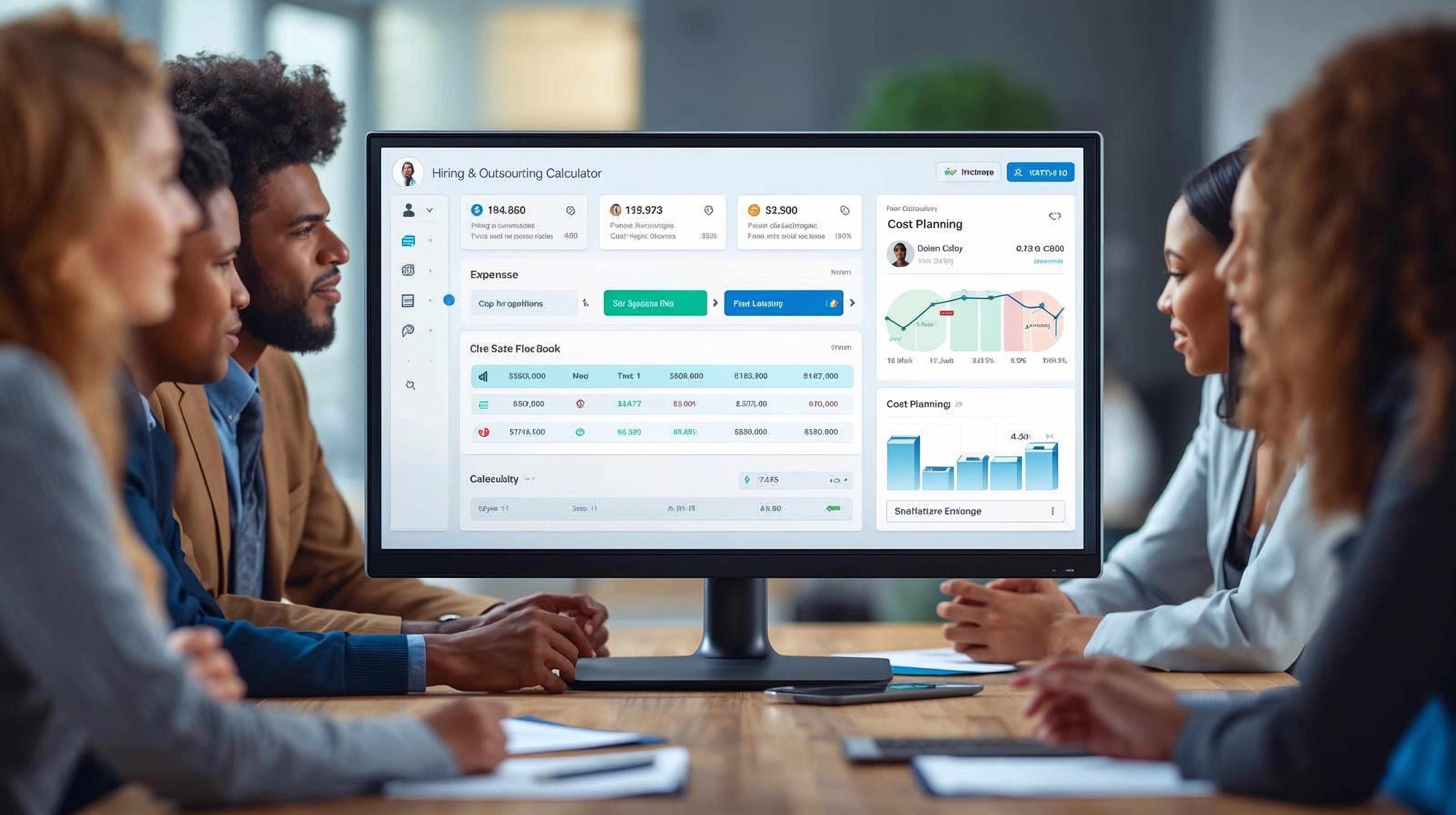
Hiring usually wins when the workload is stable, institutional knowledge matters, and the business needs tighter control over quality and decision rights. Outsourcing usually wins when speed matters more than ownership, the need is narrow or temporary, or the work can be governed cleanly with clear service expectations.
The key mistake is assuming one answer will hold forever. In many enterprise environments, outsourcing is the fastest bridge, while hiring becomes the lower-risk and lower-cost operating model once volume, complexity, and business dependency rise.
Why this decision is harder than it looks
On paper, hiring versus outsourcing can look simple. One option appears as salary plus burden. The other appears as a vendor rate multiplied by hours or a monthly retainer. That level of comparison feels efficient, but it rarely survives executive review because it ignores how work is actually delivered.
CFOs care about the total economic footprint, not just the visible line item. HR leaders care about recruiting lead time, onboarding reality, labour sustainability, and the risk of building critical processes outside the company. Operations leaders care about throughput, responsiveness, quality, escalation paths, and who owns the work when priorities shift. A credible decision model has to satisfy all three audiences at once.
What the calculator actually solves
The Hiring vs Outsourcing Calculator is not just a price checker. It is a decision support tool for organizations that need to choose the right delivery model for a recurring workflow, a specialised capability, or a growing operational burden. It helps leaders compare not only cost, but also timing, governance effort, continuity, and strategic fit.
This becomes especially important when one option looks cheaper only because part of the cost is being ignored. A full-time hire can look expensive until the vendor model is burdened with oversight, change requests, and higher-than-expected usage. Outsourcing can look efficient until the company realizes it has externalized a critical function that requires internal context, cross-functional judgment, and ongoing adaptation.
Insert one internal or third-party benchmark here, such as average time-to-fill, expected onboarding duration, vendor markup assumptions, or internal quality thresholds. This improves trust and supports stronger E-E-A-T presentation without disrupting the decision flow.
How to model hiring correctly
The most common error in the hiring path is treating base salary as the answer. Salary is only the visible beginning. A realistic model also includes payroll burden, benefits, recruiting effort, onboarding cost, manager time, tools, software, workspace support where relevant, and the temporary productivity gap that exists while a new employee ramps up.
This matters because finance often absorbs hidden cost across multiple lines, while HR carries the operational reality of time-to-fill and time-to-productivity. A role can still be the right answer even if year-one cost is higher, but the decision should be made with full visibility. When leaders only compare the cleanest parts of the hiring path, they underestimate first-year spend and then misread the variance later.
What CFOs should challenge
Ask whether the model reflects total employment cost rather than compensation alone. Confirm whether recruiting support, approvals, equipment, software access, and manager ramp-time are included. Stress-test how much value the business truly gets in the first ninety to one hundred eighty days.
What HR leaders should challenge
Ask whether the job market can actually supply the role in the assumed timeline. Confirm whether the role will be sustainable, whether internal managers can absorb the onboarding load, and whether the business is prepared to retain and develop the capability after the first hire lands.
How to model outsourcing correctly
Outsourcing models often look cleaner than they really are because many hidden costs are organizational rather than contractual. The vendor proposal may show a clear rate card, but that does not automatically represent the full economic burden. Internal leaders still spend time scoping work, reviewing output, clarifying expectations, handling escalations, approving changes, and protecting quality.
A better outsourcing model includes management oversight, transition effort, change-order risk, minimum commitment levels, knowledge-transfer friction, and rework. If the work affects customer experience, compliance, payroll, or a core operating process, leaders should also consider what happens when the vendor relationship changes or volume spikes unexpectedly.
When outsourcing is strongest
Outsourcing is often strongest when the need is specialised, demand is volatile, or speed matters more than long-term ownership. It can also be effective when the organization has mature governance, clear performance expectations, and enough internal capability to manage the relationship without constant firefighting.
When outsourcing becomes fragile
The model becomes fragile when the work depends on deep internal judgment, needs rapid cross-functional coordination, or becomes business-critical before the company has built strong controls around the vendor. In those cases, the cost line may still look manageable while the operational risk quietly grows.
Speed, control, and strategic fit
Cost alone does not close this decision. Leaders need to compare how quickly each option becomes productive and how much control the organization keeps once the work is live. A slower option may still be the better decision if it builds durable capability. A faster option may still be the right call if the business needs relief now and the work does not justify permanent headcount.
Break-even thinking
Break-even analysis is one of the most useful upgrades a guide like this can offer because it changes the conversation from opinion to threshold logic. Instead of asking which option is better in the abstract, leaders ask what volume, duration, or complexity level would cause the recommendation to flip.
That framing is especially effective for CFOs because it clarifies when outsourcing is a tactical bridge and when it becomes structurally expensive. It is equally valuable for HR because it can show when the business should stop renting capability and start building it internally.
The best executive presentation is not “hire” or “outsource.” It is “outsource for the next two quarters, then internalize once demand stabilizes above the break-even threshold.”
Scenario planning that prevents bad calls
Enterprise decisions improve when leaders model more than one future. A single case can be directionally useful, but it will not show how sensitive the recommendation is to hiring delays, demand spikes, management bandwidth, or quality drift. Scenario planning is what keeps a promising recommendation from becoming a fragile one.
Many guides explain the arithmetic but skip the decision memo logic. This version adds scenario framing that helps leaders explain not just the answer, but what assumptions would need to change before another answer becomes smarter.
How to present the decision
By the time the recommendation reaches an executive meeting, stakeholders usually want one page, not a long workbook. The strongest summary starts with the recommendation, then explains the reasoning under four headings: economics, timing, risk, and strategic fit. That keeps the narrative decision-driven rather than overly technical.
A useful format is simple. State the preferred model. State the annualized cost view. State the speed-to-value advantage or disadvantage. State the biggest risk. State the trigger that would cause the decision to be revisited. This is what turns a calculator into an executive communication tool.
“Outsource immediately to protect delivery, then review internalization once workload stabilizes above the break-even range.”
Loaded cost, implementation timing, quality and governance risk, and strategic ownership rationale.
Common mistakes
- Comparing salary to vendor rate without including burden, oversight, and rework.
- Ignoring time-to-fill and assuming a new employee is productive immediately.
- Assuming vendor flexibility will remain cheap as workload becomes permanent.
- Skipping scenario analysis and presenting only one static answer.
- Making a cost decision without addressing control, resilience, and knowledge retention.
- Separating finance logic from HR reality instead of building a shared model.
Final takeaway
The right answer is rarely “always hire” or “always outsource.” The right answer is the one that best fits the duration of the need, the criticality of the work, the organization’s management capacity, and the long-term value of owning the capability internally.
For CFOs, the win is avoiding false savings and building more reliable budget logic. For HR leaders, the win is making workforce decisions that reflect both cost discipline and sustainable capability design. For operations, the win is choosing a model that actually supports delivery instead of looking efficient only on paper.
This is where the guide becomes operational. Run the numbers, test the scenarios, and build a recommendation that finance and HR can stand behind together.
Frequently asked questions
When the workload is durable, the role needs internal context, and the company benefits from retaining knowledge and direct accountability.
When speed matters, the need is temporary or specialized, and the organization can govern the vendor cleanly.
Payroll burden, benefits, tools, onboarding, recruiting, manager time, transition effort, vendor minimums, change requests, and rework.
Yes. Shared assumptions reduce review friction and make the final recommendation more credible.